Wednesday, February 27, 2013

Teaching Sociology Conference on April 5, 2013

I received the following email via the ASA listserv. For those who may have missed it, here is a wonderful announcement.  I must confess a certain affinity to the planners and location as I taught in Indiana for 13 years and attended Valparaiso University for my undergraduate work.  I only wish I could attend this wonderful opportunity.

The email came with a registration form which can be found on this page:
https://sites.google.com/site/teachinghighschoolsociology/miscellaneous-docs

For those who go, the rest of us would love to hear what you gained from the experience.

---------------------------------------------------

Dear Social Studies/Sociology Teacher:

I invite you to participate in a workshop on teaching sociology in high school.  The workshop is sponsored by the North Central Sociological Association (NCSA), the American Sociological Association’s Section on Teaching and Learning, the Indiana Council for the Social Studies, and the Valparaiso University Department of Sociology and Criminology in Indiana. The NCSA has offered this workshop almost every year since 1991, and its design and content have been shaped by feedback from previous participants.  It includes discussion of important curricular and pedagogical issues high school teachers face.  Participants are introduced to the services of the Teaching Resources Center at the American Sociological Association and are given opportunities to network with other high school sociology teachers and professors of college level courses. You will leave the room with dozens of teaching strategies for your sociology course, but many of them are applicable to courses on government, history, or psychology as well.

The workshop is scheduled for Friday, April 5th, at the Crowne Plaza in Historic Union Station in Indianapolis, IN.  It will begin at 8:30 AM and conclude by 3:30 PM. Registration is $100 for those who pre-register by March 22nd or $125 at the door.  Registration includes lunch, provides you with several ready-to-go lessons and enables you to participate in the larger sociology conference.  A certificate for earning continuing education credits (variously named in each of the adjacent states) will be available, though application but must be initiated through your own school system if you want continuing education credits.

Enclosed you will find a description of the workshop, a registration form, and a tentative workshop agenda.

After the workshop, you are invited to participate in the rest of the annual meeting events, which run through Saturday evening.  There are both presentations of research findings by sociologists from across the midwest and sessions on various aspects of teaching sociology.

We hope to hear from you!  If you do not teach sociology yourself, please pass these materials on to a colleague who does.  Thanks!

Cordially,
Lissa J. Yogan, Ph.D. Co-Organizer                                           Debra Swanson, Ph.D.  Co- Organizer
Associate Professor of Sociology, Valparaiso University          Professor of Sociology, Hope College
Contact:  219/ 464-6998    Lissa.Yogan@valpo.edu                  Contact:  616/395-7951  swansond@hope.edu


-------------------------------------------
The Teaching High School Sociology web site

Monday, February 4, 2013

Bullying as a Rational Choice


Over the weekend I was reading through my Facebook feed--a title really jumped out at me: "Bullying: A Rational Choice."  Having a friend who teaches economics, I hear the term "rational choice" quite a bit, as that is apparently how economists view choices people make for their economic models.

Anyway, I read through the blog post and it stunned me.  There is a compelling argument that is made about the origins of bullying and how it represents a social bonding experience related to conformity (increasing oxytocin), in-groups and out-groups.  Fascinating.  I would imagine that sharing such an article with your kids would yield some insights as well.  There are some amazing sociological connections in relation to groups and group dynamics in the article.

BrainBlogger Home Page:  http://brainblogger.com/

Bullying Post:  http://brainblogger.com/2013/02/01/bullying-a-rational-choice/

posted by Chuck Schallhorn

Wednesday, January 30, 2013

Social Isolation-One Family's Story


You have a belief system and way of life that makes you distrust outsiders due to a political purge.  You live a harsh life in the forest and scavenge daily to feed yourself and your family of 5.  Without hunting or building equipment, you figure out how to create a "home" and hunt barefoot in the snow but mostly eat grasses, berries and bark.  The only people you've seen for 40 years are your family members.  How do you react to strangers and the new innovations they bring?  Would you embrace or reject the things and ideas they brought?

A student sent me a link to this article recently.  It's from Smithsonian Magazine about a family in remote Russia that was so far removed from society for over 40 years that they were not even aware that World War II had occurred.  I will not attempt to do the story justice here, just check out the article.  There is also a link to a Russian documentary about their lives at the end of the article.

http://www.smithsonianmag.com/history-archaeology/For-40-Years-This-Russian-Family-Was-Cut-Off-From-Human-Contact-Unaware-of-World-War-II-188843001.html


posted by Chuck Schallhorn


The Teaching High School Sociology web site

Tuesday, January 29, 2013

History of Anti-Semitism

I received an email today from Teaching Tolerance offering a new resource.  Below is the text from the message.  Prejudice and discrimination are two major topics in my sociology course.  One of the best ways to deal with the issue with our students is to acknowledge the historical atrocities that have occurred as well as current issues and give students a lens through which to view these events and incidents.  If this resource is as good as the previous ones from TT, it will be excellent.

In recent years, human rights organizations and government agencies have documented a surge in anti-Jewish rhetoric and acts of violence in countries around the world. A Convenient Hatred: The History of Antisemitism—the newest book by Facing History and Ourselves—reveals the stereotypes that lie at the heart of this hatred.  

Teaching Tolerance is pleased to partner with Facing History and Ourselves to offer A Convenient Hatred to you free of charge. Members of the Teaching Tolerance community may order one copy of A Convenient Hatred at no cost!  

In addition, you are invited to attend Facing History's free online workshop, A Convenient Hatred from March 15-25. The workshop will give educators the opportunity to engage in conversation about how to effectively teach the history of anti-Semitism by addressing the impact of stereotypes. 

Don't wait to order your copy of A Convenient Hatred—the offer ends February 28, 2013! 

The Teaching High School Sociology web site

Tuesday, November 20, 2012

Feral Children: TV Alert

I was searching for the old feralchildren.com site (which no longer seems to exist) when I ran across this site:  http://feralchildren.info/.  This site examines, from an anthropological point of view, what happens when children grow up in deprived circumstances.  Dr. Mary-Ann Ochota, at right, is the principal researcher and broadcaster on this series.

The first episode is "Dog Girl of Ukraine," who some of us may know as Oksana, the girl featured in the Discovery Channel show on feral children about five or six years ago.  There are also episode called "Bird Boy of Fiji" and "Monkey Boy of Uganda."  The series is currently running and you can find repeats of shows you have missed.

I've not seen the series yet, but do look forward to seeing how this scientist treats the subjects.

In what to me is a bizarre twist, the series is appearing on "The Animal Planet" network.


The Teaching High School Sociology web site

Monday, October 29, 2012

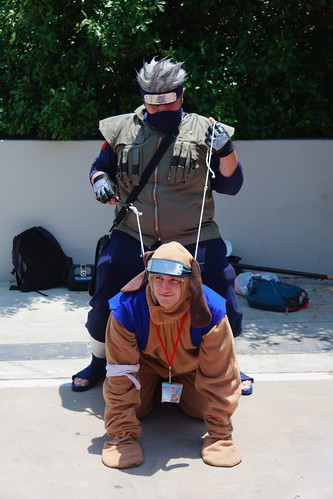
Halloween Costumes--An Analysis

I posted the blog below on the Teaching High School Psychology blog earlier.  As I was thinking about it, I realized that from a sociological perspective, analyzing costumes in the aggregate could be a great observational activity lending connections to socialization and culture and subcultural norms.

Have students create categories of costume types (the Teaching Tolerance link has some good examples).  Is the costume ethnic/racial, a fictional character from childhood or from some literature, a political figure, or something humorous.  Classes from different schools could do this analysis to see if there are different patterns that emerge in different schools, regions, or states.  What are acceptable costumes for what students wear at school versus what they might wear to parties with their friends or families?  What norms are there for the various events?  What consequences/sanctions are given for those who violate the norms of their group?

It seems to me as I write this that there are so many possibilities for this activity.  If you can, please be sure to add more in the comments section.

======================================================================
I am in my social psychology unit for regular psych and decided to take a look at what was available for analyzing costumes--whether it be for stereotypes or gender or politics.  For this post, I will simply share what I discovered in terms of some examples of what is out there.  Before using any of these with students, I would recommend checking them out yourself first.  Whether it's unleashing a hidden side of yourself or modeling someone you admire or mocking someone you abhor, the costume you wear may say a lot about you and your personality.

Just like projective tests, I would recommend being very cautious using any kind of analysis in class with students.  Perhaps it would be better to have them do the analyzing and the adults guiding them in that pursuit.

Teaching Tolerance--the most school-appropriate item I could find--costume type, gender representation, racial/ethnic or age representation
http://www.tolerance.org/activity/what-do-halloween-costumes-say

Psychoanalyzing 10 Popular Halloween Costumes from US News
http://health.usnews.com/health-news/articles/2012/10/25/psychoanalyzing-10-popular-halloween-costumes

A Psychoanalysis of Costumes from Boston.com
http://www.boston.com/dailydose/2012/10/29/weekly-challenge-psychoanalysis-your-halloween-costume-choice/Ad5FA9h9ppnFasYbkIf19J/story.html

Emme Magazine (I had not heard of it either)--a cheeky examination of costumes for women
http://www.emme-magazine.com/2012/10/21/your-halloween-costume-your-personality-dr-hughes-analyzes-what-your-halloween-costume-reveals-about-you/


Arizona Central--Women Rethinking Their Role as Eye-Candy
http://www.azcentral.com/thingstodo/specials/halloween/articles/20121026women-rethinking-roles-as-halloween-eye-candy.html

For Humor--decoding her/his costume (From Match.com)
http://www.match.com/magazine/article/9024/Decode-Her-Halloween-Costume/
http://www.match.com/magazine/article/9023/Decode-His-Halloween-Costume/

Good Girls Go Bad, For a Day
http://www.nytimes.com/2006/10/19/fashion/19costume.html?pagewanted=all&_r=0

The Glory of Wearing the Same Costume Every Year
http://www.theatlantic.com/entertainment/archive/2012/10/the-glory-of-wearing-the-same-halloween-costume-every-year/264060/

Media Analysis--a Cultural Appropriation of Halloween
http://www.karanovic.org/courses/mca006/2012/10/26/cultural-appropriation-of-halloween/

For those who like stats and lots of data analysis with their economics, there is this Stanford paper
http://www.stanford.edu/class/cs341/reports/04-PraveenCS341ProjectWrite-Up.pdf

Images courtesy of a search.creativecommons.org with images available for use without copyright protection.

posted by Chuck Schallhorn
The Teaching High School Sociology web site