Showing posts with label socialization. Show all posts

Tuesday, June 14, 2016

StoryCorps in the Sociology Classroom

I love a good story. Don't we all love a good story? This is why StoryCorps is my favorite podcast. I am so excited to begin the conversation of how we can integrate it into our classrooms.

Here is an introduction to StoryCorps from their founder, Dave Isay:


StoryCorps reminds me of Humans of New York because it displays raw emotion from real people and real relationships in a small glimpse of these people's lives. These short stories serve as a great free supplemental resource for our Sociology class.

Due to the diversity of stories they have recorded, there are limitless ways to incorporate this resource into your classroom. By searching their website by theme, you could find a story/podcast to introduce almost any of our units. (The transcripts of each podcast are also available for each story.) Hearing these short podcasts, from real people could make our course come alive for our students, they can help our students relate to our content, and is an excellent way for students to apply their sociological imaginations!

Here as an example of how you could use a podcast:

You could use this story about two black men who moved to Hollywood in the 1960s to become stuntmen to begin a discussion about the history of race, or the state of racism in different industries, or to connect current issues to the race unit (2016 Academy Awards).

Another idea is you could assign your students to record an interview with someone important in their lives, like Ms. Mieliwocki did. After listening to various podcasts throughout the course, it would be very empowering to "hand over the mic" to our students and to allow them to uncover powerful stories in their community. (Official project write up will be in the Google Drive folder before school starts.)


If you aren't intrigued yet, here is a glimpse of the impact StoryCorps has had:


The Sociology classroom can serve as the perfect platform to increase these understandings in our high schools. 

Please tell us your ideas of how you would like to use StoryCorps in the comments below!


Sunday, March 17, 2013

Rape Culture and a Teaching Opportunity

Earlier today, I awaited the news of the verdict of the trial of the two Steubenville, Ohio boys accused of committing sexual assault on the unconscious 16-year-old female classmate.  I then posted a series of links and comments on my Twitter and Facebook accounts.  This problem has many facets, from male entitlement, to distorted definitions of masculinity and femininity, irrational expectations related to alcohol and behavior, a culture that objectifies and denigrates women, and many more issues.


I also posted this picture I found online--it received a number of likes and comments:

My FB friends also had these items to say:

  • And being a high school football star or coach in a tight-knit community does not make you above common human decency or the law.
  • Too bad they got away with only being charged as juveniles.
  • I quit a "frat" that was like this. Right there in Ohio. It was so filthy and objectified the ladies so much. I have NEVER seen anything like it before or since. And I'm not Mr. Straight Arrow. Even today I like to party sometimes. It was hhhhHORRIBLE. This kind of stuff should be SNUFFED OUT FOR EVVVER!
  • Reading that was so sad. I hope everyone involved (coach included) has to face a fitting consequence. Also, where were any adults during this? There's alcohol, driving around (with or without alcohol?), a drunk girl that no one seems to account for until the next day... Sad.
  • Very true- it's not an issue about women or men, it's an issue within our society and culture that needs to be changed. I think because it's such a "bad" topic though, it's only gonna get pushed aside because people don't want to admit that it is something that is wrong within our culture (something wrong with us?? Never!). More awareness is a good start.
  • Chuck- do K-12 programs ever address this? I'm not saying play parents...but currently K-12 have programs about drinking and driving, drugs, etc. Seems to be a good way to address some problems in a rape culture.
  • I never heard of positive masculinity till now, but found this:http://positivepsychologynews.com/news/bridget-grenville-cleave/2010102714017

    Most of what I read just now seems good..but all this "must provide" "must protect" stuff seems a bit outdat
    ed. Can't a mother provide and/or protect? I mean yes I can do more physical damage, but that's not the only protection. 

    As to providing...I'm in that boat now. But I know other couples the women make more money. I don't think there's any shame to a stay at home dad either. If a man gets his career sidetracked by the economy or chooses to stay at home because he has a contractor kind of job, or wife makes more money, etc.

    I do wish this article in the "shared activities" would have listed another example than sports. We've put that one way to high on a golden pedestal in this nation, especially with k-12.
    positivepsychologynews.com
      Kiselica and Englar-Carlson look at how Positive Psychology can be used to support troubled men and boys. They discuss a strengths-based approach known as Positive Masculinity. As the mother of a rapidly-growing boy (aged 8, going on 18), I was very interested to come across the Positive Masculi...

  • And we still have a ways to go. I was sickened by the recent exchange on Sean Hannity in which a woman (who survived a rape) debated Hannity about guns and rape. She advocated "teach boys not to rape" over carrying a firearm.
    The reaction of the Hannity faithful was disgusting.

    http://politix.topix.com/homepage/4986-woman-receives-rape-threats-after-telling-hannity-guns-wont-prevent-rape
    politix.topix.com
    Woman Receives Rape Threats After Telling Hannity Guns Won't Prevent Rape: Teaching men is the way to prevent rape, she said on the show, Democratic strategist Zerlina Maxwell, herself a rape survivor, appeared on Sean Hannity's show to talk about rape. A...

  • Is it a rape culture or a sexual objectification culture we have? Or both? There are few of us men who actually rape women, but many of us look at them and treat them as sexual objects through our looks, comments, attention, and obsession with porn. This is not at all to minimize the vileness of rape, but to say as men, I believe we need to stand against much more than just rape.

There were many more comments, but this is a good representation.  Now if we all can have these conversations in our classrooms, yes, even at the high school level, it would help being awareness to what is going on outside our classes.

So these are some issues that need to be out there and confronted in our classrooms.  I've always been fortunate enough to teach in schools that allow me to ask my students questions.  I doubt that everyone could do this, but it is worth a shot.  I will endeavor to follow up on this issue with more resources.


The Teaching High School Sociology web site

Tuesday, November 20, 2012

Feral Children: TV Alert

I was searching for the old feralchildren.com site (which no longer seems to exist) when I ran across this site:  http://feralchildren.info/.  This site examines, from an anthropological point of view, what happens when children grow up in deprived circumstances.  Dr. Mary-Ann Ochota, at right, is the principal researcher and broadcaster on this series.

The first episode is "Dog Girl of Ukraine," who some of us may know as Oksana, the girl featured in the Discovery Channel show on feral children about five or six years ago.  There are also episode called "Bird Boy of Fiji" and "Monkey Boy of Uganda."  The series is currently running and you can find repeats of shows you have missed.

I've not seen the series yet, but do look forward to seeing how this scientist treats the subjects.

In what to me is a bizarre twist, the series is appearing on "The Animal Planet" network.


The Teaching High School Sociology web site

Monday, October 29, 2012

Halloween Costumes--An Analysis

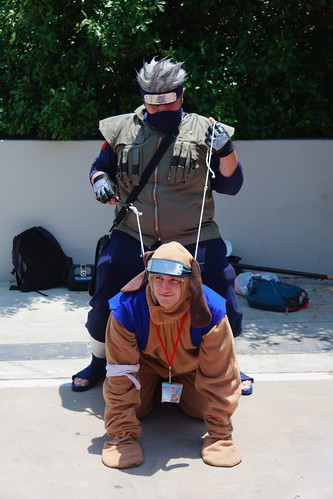
I posted the blog below on the Teaching High School Psychology blog earlier.  As I was thinking about it, I realized that from a sociological perspective, analyzing costumes in the aggregate could be a great observational activity lending connections to socialization and culture and subcultural norms.

Have students create categories of costume types (the Teaching Tolerance link has some good examples).  Is the costume ethnic/racial, a fictional character from childhood or from some literature, a political figure, or something humorous.  Classes from different schools could do this analysis to see if there are different patterns that emerge in different schools, regions, or states.  What are acceptable costumes for what students wear at school versus what they might wear to parties with their friends or families?  What norms are there for the various events?  What consequences/sanctions are given for those who violate the norms of their group?

It seems to me as I write this that there are so many possibilities for this activity.  If you can, please be sure to add more in the comments section.

======================================================================
I am in my social psychology unit for regular psych and decided to take a look at what was available for analyzing costumes--whether it be for stereotypes or gender or politics.  For this post, I will simply share what I discovered in terms of some examples of what is out there.  Before using any of these with students, I would recommend checking them out yourself first.  Whether it's unleashing a hidden side of yourself or modeling someone you admire or mocking someone you abhor, the costume you wear may say a lot about you and your personality.

Just like projective tests, I would recommend being very cautious using any kind of analysis in class with students.  Perhaps it would be better to have them do the analyzing and the adults guiding them in that pursuit.

Teaching Tolerance--the most school-appropriate item I could find--costume type, gender representation, racial/ethnic or age representation
http://www.tolerance.org/activity/what-do-halloween-costumes-say

Psychoanalyzing 10 Popular Halloween Costumes from US News
http://health.usnews.com/health-news/articles/2012/10/25/psychoanalyzing-10-popular-halloween-costumes

A Psychoanalysis of Costumes from Boston.com
http://www.boston.com/dailydose/2012/10/29/weekly-challenge-psychoanalysis-your-halloween-costume-choice/Ad5FA9h9ppnFasYbkIf19J/story.html

Emme Magazine (I had not heard of it either)--a cheeky examination of costumes for women
http://www.emme-magazine.com/2012/10/21/your-halloween-costume-your-personality-dr-hughes-analyzes-what-your-halloween-costume-reveals-about-you/


Arizona Central--Women Rethinking Their Role as Eye-Candy
http://www.azcentral.com/thingstodo/specials/halloween/articles/20121026women-rethinking-roles-as-halloween-eye-candy.html

For Humor--decoding her/his costume (From Match.com)
http://www.match.com/magazine/article/9024/Decode-Her-Halloween-Costume/
http://www.match.com/magazine/article/9023/Decode-His-Halloween-Costume/

Good Girls Go Bad, For a Day
http://www.nytimes.com/2006/10/19/fashion/19costume.html?pagewanted=all&_r=0

The Glory of Wearing the Same Costume Every Year
http://www.theatlantic.com/entertainment/archive/2012/10/the-glory-of-wearing-the-same-halloween-costume-every-year/264060/

Media Analysis--a Cultural Appropriation of Halloween
http://www.karanovic.org/courses/mca006/2012/10/26/cultural-appropriation-of-halloween/

For those who like stats and lots of data analysis with their economics, there is this Stanford paper
http://www.stanford.edu/class/cs341/reports/04-PraveenCS341ProjectWrite-Up.pdf

Images courtesy of a search.creativecommons.org with images available for use without copyright protection.

posted by Chuck Schallhorn
The Teaching High School Sociology web site