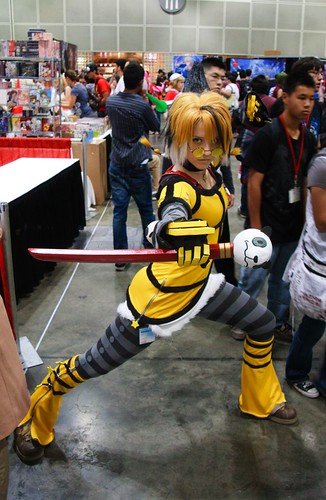
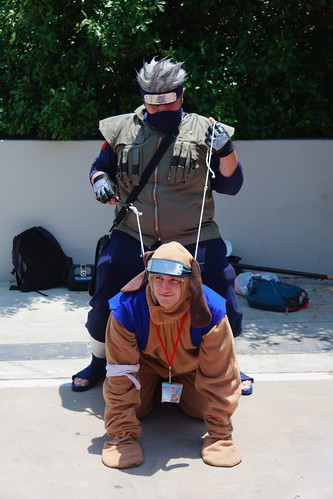
I posted the blog below on the Teaching High School Psychology blog earlier. As I was thinking about it, I realized that from a sociological perspective, analyzing costumes in the aggregate could be a great observational activity lending connections to socialization and culture and subcultural norms.
Have students create categories of costume types (the Teaching Tolerance link has some good examples). Is the costume ethnic/racial, a fictional character from childhood or from some literature, a political figure, or something humorous. Classes from different schools could do this analysis to see if there are different patterns that emerge in different schools, regions, or states. What are acceptable costumes for what students wear at school versus what they might wear to parties with their friends or families? What norms are there for the various events? What consequences/sanctions are given for those who violate the norms of their group?
It seems to me as I write this that there are so many possibilities for this activity. If you can, please be sure to add more in the comments section.
======================================================================

I am in my social psychology unit for regular psych and decided to take a look at what was available for analyzing costumes--whether it be for stereotypes or gender or politics. For this post, I will simply share what I discovered in terms of some examples of what is out there. Before using any of these with students, I would recommend checking them out yourself first. Whether it's unleashing a hidden side of yourself or modeling someone you admire or mocking someone you abhor, the costume you wear may say a lot about you and your personality.
Just like projective tests, I would recommend being very cautious using any kind of analysis in class with students. Perhaps it would be better to have them do the analyzing and the adults guiding them in that pursuit.
Teaching Tolerance--the most school-appropriate item I could find--costume type, gender representation, racial/ethnic or age representation
http://www.tolerance.org/activity/what-do-halloween-costumes-say
Psychoanalyzing 10 Popular Halloween Costumes from US News
http://health.usnews.com/health-news/articles/2012/10/25/psychoanalyzing-10-popular-halloween-costumes
A Psychoanalysis of Costumes from Boston.com
http://www.boston.com/dailydose/2012/10/29/weekly-challenge-psychoanalysis-your-halloween-costume-choice/Ad5FA9h9ppnFasYbkIf19J/story.html
Emme Magazine (I had not heard of it either)--a cheeky examination of costumes for women
http://www.emme-magazine.com/2012/10/21/your-halloween-costume-your-personality-dr-hughes-analyzes-what-your-halloween-costume-reveals-about-you/

Arizona Central--Women Rethinking Their Role as Eye-Candy
http://www.azcentral.com/thingstodo/specials/halloween/articles/20121026women-rethinking-roles-as-halloween-eye-candy.html
For Humor--decoding her/his costume (From Match.com)
http://www.match.com/magazine/article/9024/Decode-Her-Halloween-Costume/
http://www.match.com/magazine/article/9023/Decode-His-Halloween-Costume/
Good Girls Go Bad, For a Day
http://www.nytimes.com/2006/10/19/fashion/19costume.html?pagewanted=all&_r=0
The Glory of Wearing the Same Costume Every Year
http://www.theatlantic.com/entertainment/archive/2012/10/the-glory-of-wearing-the-same-halloween-costume-every-year/264060/
Media Analysis--a Cultural Appropriation of Halloween
http://www.karanovic.org/courses/mca006/2012/10/26/cultural-appropriation-of-halloween/
For those who like stats and lots of data analysis with their economics, there is this Stanford paper
http://www.stanford.edu/class/cs341/reports/04-PraveenCS341ProjectWrite-Up.pdf
Images courtesy of a
search.creativecommons.org with images available for use without copyright protection.
posted by Chuck Schallhorn
The Teaching High School Sociology web site
 You have a belief system and way of life that makes you distrust outsiders due to a political purge. You live a harsh life in the forest and scavenge daily to feed yourself and your family of 5. Without hunting or building equipment, you figure out how to create a "home" and hunt barefoot in the snow but mostly eat grasses, berries and bark. The only people you've seen for 40 years are your family members. How do you react to strangers and the new innovations they bring? Would you embrace or reject the things and ideas they brought?