Friday, March 6, 2015

Sneetches, Prejudice, Discrimination, and Status


Dr. Seuss gave us many classics in regards to human behavior. My personal favorite is "Sneetches," a story about two kinds of Sneetches, creatures who lived on the beach, some of whom had stars on their bellies, some who did not.

Those with stars fancied themselves better than the others and excluded those without stars from their social gatherings. Those with stars also had stereotypes about those without. This led to discrimination, name calling, and social shunning. Along comes an inventor who can put stars on those without. Conflict ensues when the originals with stars feel the need to change once all Sneetches had stars--they needed some visible identifier for in- and out-group labeling.

Then the inventor who took the stars off the original star-bellied Sneetches.  They reclassified the status of both kinds of bellies.

This new designation leads to chaos as both groups end up adding and subtracting the stars so that everything gets messed up from the original grouping.  No identifiers work for in- and out-group designations.

Lessons are learned and the scam artist leaves.

The video version is available here:


Posted by Chuck Schallhorn

The Teaching High School Sociology web site

Sunday, February 15, 2015

The Average Black Girl


A friend just posted this on her facebook page.  So incredibly powerful.  Take the time to listen to Ernestine Johnson.

Wednesday, January 28, 2015

Ghettocide: A True Story of Murder in America

The other day I had one of those NPR moments when I was driving home and could not turn off the engine until I had finished listening to the story that was playing.  It was an interview with the author of Ghettocide: A True Story of Murder in America.  The author was talking on Fresh Air and discussing different kinds of grief that people experience.  She had interviewed many people who had lost loved ones and she noticed that their experiences with death were different and had longer lasting impacts especially if there was no closure of an arrest of the perpetrator.  Her interview was so riveting, I ordered the book and will receive it tomorrow.

Listen or read here: http://www.npr.org/2015/01/26/381589023/ghettoside-explores-why-murders-are-invisible-in-los-angeles

Here is her appearance on the Daily Show


posted by Chuck Schallhorn


The Teaching High School Sociology web site

Monday, January 26, 2015

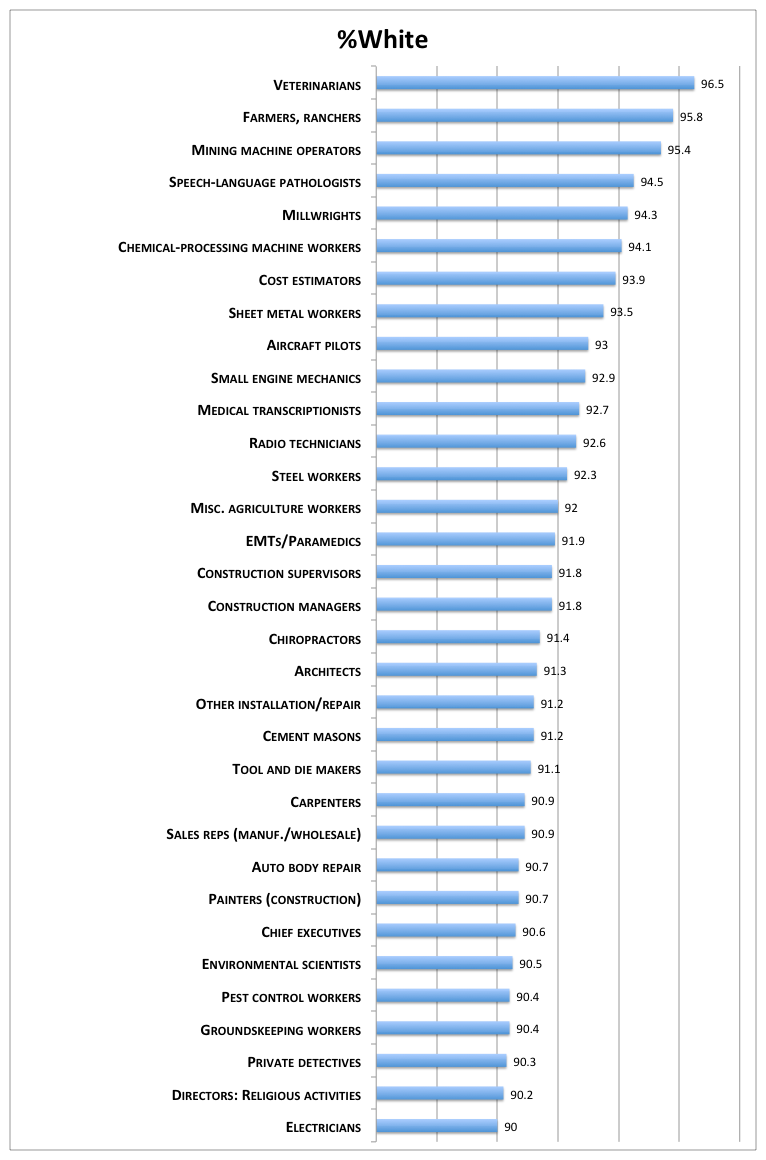
The Whitest Jobs in America

I knew segregation was still alive and well, but this article in The Atlantic shows just how segregated these aspects of America still is. Original article is here.


The Teaching High School Sociology web site

Friday, January 23, 2015

The Crayola Monologues: A Commentary on Color and Society


I found this as a video file that I received from Amy Jones at a conference a few years ago. I am still sifting through all the amazing resources she shared.

This video is called, "The Crayola Monologues."  It is sharable for all ages, but especially great for social psychology and prejudice/bigotry issues.  To be honest, I love this video.  The artist who created it can be found at this link: http://www.nathangibbs.com/crayola-monologues/.  This page contains lengthy commentary and exploration of color, race, and ethnicities and issues surrounding these ideas in our society.


posted by Chuck Schallhorn

The Teaching High School Sociology web site